
The western growth corridor is where Melbourne’s next decade of household formation, infrastructure and employment is being built.
Melbourne’s western growth corridor is no longer a frontier story. It is one of the fastest-growing urban regions in Australia, absorbing tens of thousands of new residents each year across Wyndham, Werribee, Williams Landing and Tarneit. For a multi-sector developer, that growth is not an abstraction — it is the demographic engine behind residential demand, childcare demand, healthcare demand and the commercial precincts that knit a community together. Nexus Developments is anchored in this corridor by design, and this analysis sets out why. You can review the full portfolio on the All Projects page.
WHAT THIS GUIDE COVERS
01. Why the western corridor matters now
02. Population growth and household formation
03. Infrastructure investment is following the people
04. Employment and the shift toward local jobs
05. Why Nexus Developments is anchored in the west
06. The Sunshine Precinct and Wyndham Grammar School
07. Reading the corridor as an investor
08. The disciplined view of growth-corridor risk
09. Frequently asked questions
Why the western corridor matters now
Melbourne’s western growth corridor spans the local government areas of Wyndham, Melton and parts of Hobsons Bay, with Wyndham and Werribee at its core. For two decades it has been one of the principal release valves for Melbourne’s housing demand, and the pace has not slowed. The corridor is where household formation, land supply and infrastructure spending intersect, which makes it structurally important to anyone allocating capital to Victorian property. Nexus Developments treats the west not as a single suburb bet but as a long-horizon region where multiple sectors compound.
The case for the corridor rests on fundamentals rather than sentiment. A growing population needs homes, schools, childcare places, medical centres and retail. Each of those is a distinct asset class, and each is represented inside the Nexus Developments operating model through dedicated verticals. That is the lens this analysis applies — not whether the west is fashionable, but whether the demographic and infrastructure data support sustained, investment-grade demand.
A stylised map of Melbourne’s suburbs — the western growth corridor sits to the city’s west, spanning Wyndham, Werribee, Williams Landing and Tarneit.
Population growth and household formation
Wyndham has consistently ranked among the fastest-growing local government areas in the country. The drivers are well understood: comparative affordability against Melbourne’s established middle ring, a steady supply of greenfield and infill land, and a young demographic profile that generates strong household formation. Young households form, partner, have children and trade up — and each stage of that lifecycle creates demand for a different product.
That lifecycle is precisely why Nexus Developments structures its activity across Nexus Communities, Nexus Learning and Nexus Care rather than a single product line. A residential estate sells homes to families; those families need childcare places; an ageing cohort needs accessible housing and medical services. A developer that reads the corridor only as a land subdivision opportunity is reading half the page.

Exterior render of a Nexus Developments luxury townhome project — household formation across the lifecycle drives demand for a range of residential products.
- A young median age in the western corridor sustains demand for family housing and childcare for years rather than quarters.
- Comparative affordability relative to Melbourne’s middle ring keeps the corridor attractive to first-home buyers and upgraders alike.
- Continued land release, both greenfield and infill, supports an orderly pipeline rather than supply shocks.
- Population growth of this scale generates demand across residential, education, healthcare and commercial sectors simultaneously.
Infrastructure investment is following the people
Population growth alone does not make a corridor investment-grade. Infrastructure does. The western corridor has attracted sustained public investment in road and rail capacity, and the maturing of stations such as Williams Landing has reshaped commuting patterns and land values around them. Transport access is one of the most reliable predictors of long-run land value, and the corridor has been a clear beneficiary.
Nexus Developments locates its head office at 314/101 Overton Rd, Williams Landing VIC 3027 — not as a matter of convenience, but as a statement about where the firm believes the next decade of value is being created. Being physically embedded in the corridor sharpens market intelligence: site visits, council relationships, contractor availability and buyer sentiment are all easier to read from inside the region than from a CBD tower.
Infrastructure investment also tends to compound. A new road or an upgraded station does not deliver its full value on the day it opens; it shapes development patterns, employment decisions and household choices for years afterwards. A corridor that has absorbed sustained infrastructure spending is therefore not just better connected today — it carries forward momentum that an undercapitalised region cannot replicate. Nexus Developments factors that compounding effect into how it stages projects, recognising that the corridor’s accessibility will continue to improve over the life of a typical development.
Infrastructure is the difference between a population that is merely large and a corridor that is genuinely investment-grade.
Employment and the shift toward local jobs
For much of its history, the western corridor was characterised as a dormitory region — residents commuted east to work. That picture is changing. Investment in logistics, advanced manufacturing, health, education and retail employment within the west is gradually rebalancing the journey-to-work equation. Local jobs reduce commute times, support local retail spend and deepen the case for mixed-use precincts.
This shift matters because employment is what converts a growth corridor from a housing estate into a community. It is also why Nexus Developments invests in education and commercial assets in the west rather than residential alone. A school employs staff. A childcare centre employs educators. A mixed-use precinct creates retail and entrepreneurial jobs. Each of these strengthens the corridor’s self-sufficiency, and the firm’s tagline — “Building Sustainable Communities. Distributing Wealth.” — speaks directly to that ambition.
There is a financial dimension to local employment as well. When residents work within the corridor, more of their income is spent locally, which deepens the retail catchment and supports the commercial precincts a developer brings to market. A corridor with a healthy local jobs base is therefore more resilient through economic cycles than a pure dormitory region, because its economy is not wholly dependent on a single distant employment centre. Nexus Developments reads this resilience as a core part of the western corridor investment case.
Why Nexus Developments is anchored in the west
Nexus Developments operates a $400M+ pipeline across 16 active projects and 7 sectors. While the portfolio is geographically diversified — from Bayside luxury townhouses to regional Victorian projects — the western corridor is a deliberate anchor. The firm’s founders built this position over time: Vish Singh, Founder of Nexus Developments, drove the pipeline to $340M over five years before its current scale, and the west has been central to that trajectory.
The reasoning is straightforward. A multi-sector developer needs a region deep enough to support several verticals at once, with land supply, population growth and infrastructure all moving in the same direction. The western corridor offers exactly that depth. It allows Nexus Communities, Nexus Learning and Nexus Commercial to operate in proximity, sharing market intelligence and contractor relationships.

A render of a Discovery Cove Montessori-philosophy childcare centre — childcare demand is one of the clearest signals of a young, growing corridor.
The Sunshine Precinct and Wyndham Grammar School
Two western projects illustrate how Nexus Developments translates corridor analysis into delivery. The Sunshine Precinct is a $48M mixed-use accommodation, retail and entrepreneurship hub at Sunshine VIC 3020, currently Coming Soon. It is designed to do exactly what the corridor needs — concentrate housing, retail and enterprise in a single walkable location, supporting local employment rather than commuting.
The Wyndham Grammar School is a $52M project at Wyndham VIC for up to 800 students across a two-level campus, currently Under Planning. Education infrastructure is among the most powerful anchors a growth corridor can have: it draws families, supports long-term residence and signals confidence in the region’s future. You can review the project on the Wyndham Grammar School page.
Together, these two projects represent $100M of committed western corridor investment in education and mixed-use development alone. They are not speculative land plays — they are community infrastructure, delivered by a firm that has chosen to be physically headquartered in the same corridor.
The choice to commit at this scale reflects a particular reading of the corridor. Education and mixed-use precincts are long-duration assets that only make sense if the demand behind them is durable. By advancing the Wyndham Grammar School and the Sunshine Precinct, Nexus Developments is signalling confidence that the western corridor’s population, infrastructure and employment trajectory will continue for the long horizon over which such assets are designed to perform. That is the corridor case expressed as committed capital rather than commentary.
Reading the corridor as an investor
For wholesale and sophisticated investors, the western corridor offers a rare combination: scale, diversity and a long demand runway. The investment-grade view is to look past any single suburb or product and ask whether the underlying drivers — population, infrastructure, employment — are durable. In the western corridor they are. Nexus Developments expresses this through the Nexus Wealth Fund, which spans three distinct funds: the Equity Fund, the Income Stream and Capital Growth Fund, and the Absolute Return Fund.
The discipline lies in matching the fund structure to the asset. A greenfield residential estate has a different cash-flow profile to a leased medical centre or an education campus. By operating multiple funds, Nexus Developments allows capital to be allocated to the risk and return profile each investor is seeking, while keeping all of it grounded in the same well-understood corridor fundamentals.
Investors should also weigh the value of geographic concentration done deliberately. Spreading capital thinly across many unrelated regions can dilute the very local knowledge that produces good development outcomes. By contrast, a developer with deep, sustained presence in one corridor accumulates relationships, planning experience and contractor networks that genuinely lower execution risk. Nexus Developments treats its western corridor depth as exactly that kind of asset — concentration that improves, rather than dilutes, the quality of decisions.
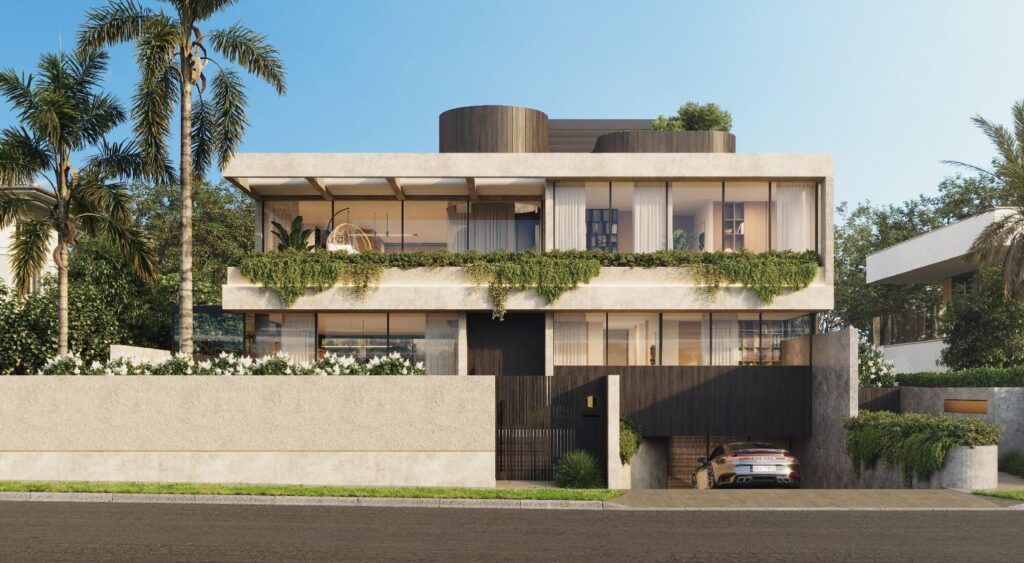
Exterior render of a Nexus Developments residential project — the firm’s funds are matched to the cash-flow profile of each asset type.
The disciplined view of growth-corridor risk
No corridor is without risk. Growth regions can experience supply gluts, infrastructure timing mismatches and shifts in lending conditions. The disciplined response is not to avoid the corridor but to manage exposure deliberately — staging releases, securing build-cost certainty at acquisition, and diversifying across sectors so that a soft patch in one product does not threaten the whole portfolio.
Nexus Developments applies institutional-grade governance to exactly this question, working with Colliers for advisory and market intelligence and Maddocks for legal, planning and compliance. That governance framework is what allows a firm to be confidently anchored in a high-growth corridor without being over-exposed to any single point of failure. To discuss the western corridor pipeline in detail, contact the team via the Contact page.
The conclusion for wholesale and sophisticated investors is measured rather than promotional. Melbourne’s western growth corridor is not a guaranteed outcome, but it is one of the best-supported long-horizon stories in Victorian property, underpinned by population, infrastructure and employment that all point the same way. Nexus Developments has chosen to anchor itself there deliberately, and the western corridor projects within its $400M+ pipeline are the practical expression of that conviction.
Frequently asked questions
Why is Nexus Developments headquartered in Williams Landing?
Nexus Developments locates its head office at 314/101 Overton Rd, Williams Landing VIC 3027 because the western growth corridor is a deliberate anchor for its $400M+ pipeline. Being physically embedded in the corridor sharpens market intelligence on council relationships, contractor availability and buyer sentiment.
Which Nexus Developments projects sit in the western corridor?
The Sunshine Precinct, a $48M mixed-use hub at Sunshine VIC 3020, and the Wyndham Grammar School, a $52M campus for up to 800 students at Wyndham VIC, are both western corridor projects. Nexus Developments also runs its head office in Williams Landing.
What makes a growth corridor investment-grade rather than speculative?
Nexus Developments assesses a corridor on durable fundamentals — sustained population growth, committed infrastructure investment and a shift toward local employment. The western corridor satisfies all three, which is why Nexus Developments treats it as a long-horizon region rather than a single-suburb bet.
How does Nexus Developments diversify within one corridor?
Nexus Developments operates across 7 sectors, so a single corridor supports residential, education, healthcare and commercial assets simultaneously. This multi-sector approach means a soft patch in one product does not threaten the wider portfolio.
Can investors gain exposure to the western corridor through Nexus Developments?
Yes. The Nexus Wealth Fund spans three funds — the Equity Fund, the Income Stream and Capital Growth Fund, and the Absolute Return Fund — allowing wholesale and sophisticated investors to match a fund structure to their preferred risk and return profile.
About Nexus Developments
Nexus Developments is a leading multi-sector property development company based in Melbourne, Australia, with a project pipeline of over $400 million across residential, NDIS Specialist Disability Accommodation, Montessori-philosophy childcare, education and commercial real estate. Founded by Bhupendra (Ben) Sethia — a 25-year industry leader and Founder Chairman of JITO Australia — and Vish Singh, Nexus Developments operates with institutional-grade governance, partnerships with Colliers and Maddocks, a 7-8 star NatHERS energy standard on every new dwelling, and a commitment to contribute more than 600 dwellings to the National Housing Accord.
Across Nexus Communities, Nexus Care, Nexus Learning, Nexus Commercial and the Nexus Wealth Fund, Nexus Developments delivers projects designed to compound long-term value for investors and communities alike. Whether you are an investor seeking exposure to Melbourne property development, a first-home buyer looking at Melbourne growth corridors, a family considering NDIS-accredited Specialist Disability Accommodation, or a landowner looking for a delivery partner, Nexus Developments has a pathway for you.
Take the next step with Nexus Developments
- Explore current Nexus Developments projects across Melbourne and regional Victoria →
- Register your interest in a Nexus Developments residential community →
- Speak to our investor relations team about the Nexus Wealth Fund →
- Learn how Nexus Care designs SDA housing built for independence →
- Read more insights and market intelligence from the Nexus team →
- Contact Nexus Developments →
Building Sustainable Communities · Distributing Wealth
Nexus Developments APAC · nexusdevelopments.com.au · info@nexusdevelopments.com.au
Disclaimer: This article is general information only and does not constitute financial, investment, legal or tax advice. Investments in Nexus Wealth Fund products are available to wholesale and sophisticated investors as defined under the Corporations Act 2001 (Cth). Past performance is not a reliable indicator of future performance. Renders are artist impressions and indicative only.