
An absolute-return strategy is not about beating a benchmark — it is about generating positive returns whatever the property market is doing.
Most property funds are built to ride a single direction of travel. They perform when prices rise and they struggle when prices stall. The Absolute Return Fund — the third vehicle within the Nexus Wealth Fund family — is built on a different premise. Its objective is to target positive returns across the full property cycle, not simply during the upswing. This guide explains how an absolute-return objective works, why a diversified development pipeline supports it, and who the strategy is designed for.
WHAT THIS GUIDE COVERS
01. What an absolute-return objective actually means
02. Why a multi-sector pipeline supports the strategy
03. How development margin creates return that does not depend on price growth
04. Risk management across the cycle
05. Where the Absolute Return Fund sits among the three Nexus funds
06. Who the Absolute Return Fund is designed for
07. Governance, transparency and reporting
08. How to start a conversation with Nexus Developments
09. Frequently asked questions
What an absolute-return objective actually means
A relative-return fund measures success against a benchmark. If the benchmark falls ten per cent and the fund falls eight, the manager has technically outperformed — even though the investor has lost money. An absolute-return objective rejects that logic. The Absolute Return Fund, the third vehicle within the Nexus Wealth Fund, is structured to target a positive result in its own right, measured in dollars returned to investors rather than basis points above an index.
This distinction matters most when markets are flat or falling. Melbourne property does not move in a straight line, and a strategy that only works during the upswing is not a strategy at all. Nexus Developments designed the Absolute Return Fund so that the source of return is the development process itself — the disciplined conversion of raw or underused land into completed, income-producing or saleable assets — rather than a passive bet on rising prices.
Stylised map of Melbourne’s suburbs and growth corridors, where the Nexus Developments pipeline is concentrated.
An absolute-return objective is a target, not a guarantee. No fund can promise a positive number in every reporting period, and Nexus Developments is explicit about that. What the structure does is shift the centre of gravity: instead of relying on the market to do the heavy lifting, the Absolute Return Fund relies on a development margin that the Nexus Project Management team can plan, control and report against.
This is also why the Absolute Return Fund tends to suit investors who think in terms of years rather than quarters. Property development is a multi-year discipline, and the return on a project is earned over the time it takes to acquire a site, secure approvals, build and settle. An absolute-return objective is honest about that horizon. It does not pretend that development margin can be crystallised on demand; it commits instead to a process that has a strong probability of delivering a positive result by the time a project reaches completion, regardless of where the wider market sits on that day.
Why a multi-sector pipeline supports the strategy
An absolute-return objective is only credible if the manager has more than one way to generate return. Nexus Developments runs a $400M+ pipeline across 16 active projects and 7 sectors — residential estates, luxury townhouses, NDIS Specialist Disability Accommodation, childcare, education, commercial precincts and resort-style retirement living. That breadth is not a marketing point. It is the engine that makes an absolute-return strategy possible.
Different sectors respond to different forces. The demand for Nexus Care Specialist Disability Accommodation is driven by the National Disability Insurance Scheme and is largely uncorrelated with the residential sales cycle. Childcare demand under Nexus Learning tracks population and workforce participation. Bayside luxury housing responds to a scarcity dynamic. When one sector slows, the pipeline is not idle — capital and management attention can be directed toward the sectors that are working.
- Residential land subdivision in growth corridors, where Nexus Developments holds projects such as Armstrong Grove and The Clan Estate.
- Specialist Disability Accommodation through Nexus Care, with a 32-apartment SDA pipeline and $52M of combined Care gross realisable value.
- Childcare and education assets through Nexus Learning, including a childcare pipeline serving 220 children.
- Bayside luxury housing through Nexus Communities, where Lune Black Rock and Esplanade Brighton together comprise 9 luxury homes.
- Mixed-use commercial precincts through Nexus Commercial.
Diversification is not about owning a longer list of assets. It is about owning assets that do not all fail on the same day.
How development margin creates return that does not depend on price growth
The core return source for the Absolute Return Fund is development margin — the difference between the all-in cost of delivering a project and its end value once complete. A developer who buys land well, controls the planning timeline, manages construction cost and sells or leases into genuine demand can crystallise margin even in a flat market. Nexus Developments treats each of those steps as a discipline rather than an outcome.
Consider a completed Nexus Developments project such as The Clan Estate — 61 residential lots on Lewis Street, Beveridge, with a $18.5M end value. The return on a project of that kind is earned by buying the land at the right basis, securing the right planning outcome and delivering titled lots into a corridor with structural population growth. None of those levers requires the broader market to rise; they require execution.
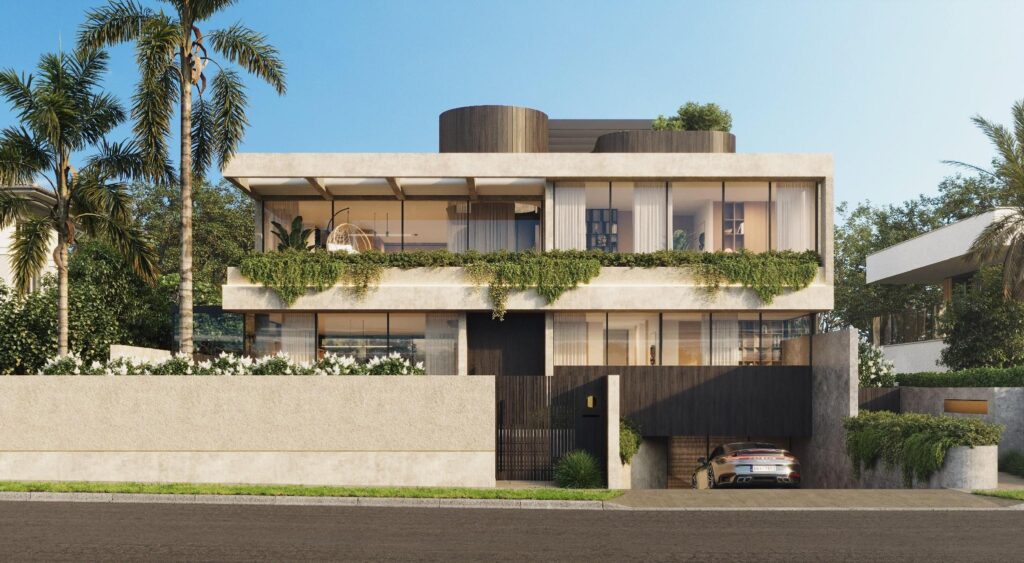
Exterior render of the Esplanade Brighton luxury homes, one of the higher-margin residential projects in the Nexus Developments pipeline.
This is why the Absolute Return Fund is anchored to a real development business. The fund is not a financial overlay sitting on top of someone else’s projects. It draws on the same pipeline, the same governance partners and the same delivery team that Nexus Developments uses across every vertical, which means the return target is connected to assets the manager can actually influence.
A useful way to think about it is the distinction between manufactured return and market return. Market return is what the broader property cycle hands an owner who simply holds an asset and waits. Manufactured return is what a developer creates by improving land — by adding planning approval, by adding built form, by adding income. The Absolute Return Fund is deliberately weighted toward manufactured return, because manufactured return is the part of the equation that Nexus Developments controls. When the market adds a tailwind, that is welcome. When it does not, the strategy is not left with nothing to show.
Risk management across the cycle
Targeting positive returns across the cycle demands a serious approach to risk. Nexus Developments manages development risk on several fronts at once: planning risk, construction cost risk, sales and leasing risk, and capital structure risk. Each project in the $400M+ pipeline is staged, and the company sequences projects so that capital is not over-committed to a single sector or a single delivery window.
Staging, sequencing and not forcing a sale
One of the most important risk controls in an absolute-return strategy is the ability to choose when to sell. A developer forced to settle stock into a weak market gives away margin. By holding a diversified pipeline at different stages — projects under planning, under construction and completed — Nexus Developments retains optionality. Income-producing assets such as Specialist Disability Accommodation and childcare centres can be held and leased rather than sold at a discount, supporting the fund through softer conditions.
Construction cost is managed through the Nexus Project Management delivery arm and a panel of established consultants, including engineering, planning and design partners. Every new dwelling is built to a 7-8 star NatHERS energy rating, which is both an ESG commitment and a hedge against tightening building standards and rising energy costs over the life of an asset.
Where the Absolute Return Fund sits among the three Nexus funds
The Nexus Wealth Fund is not a single product. It comprises three distinct vehicles, each with a different objective. Understanding the difference helps an investor match a fund to a goal.
- The Equity Fund is oriented toward capital appreciation through direct development equity exposure.
- The Income Stream & Capital Growth Fund is designed to blend regular income with longer-term growth.
- The Absolute Return Fund targets positive returns across the property cycle, with diversification across sectors as its defining feature.
The Absolute Return Fund is the most cycle-aware of the three. Where the Equity Fund leans into the upside of development equity and the Income Stream & Capital Growth Fund leans into yield, the Absolute Return Fund is built for investors who want their property exposure to be less dependent on the timing of the market. All three funds draw on the same underlying Nexus Developments pipeline and the same governance framework.
Some investors hold more than one of the three funds, using them as complementary building blocks rather than competing alternatives. An investor might pair the income orientation of one fund with the cycle resilience of the Absolute Return Fund, for example. The Nexus Developments investor relations team treats this as a planning conversation: the right combination depends on an investor’s objectives, time horizon, liquidity needs and the advice they receive from their own financial professionals.
Who the Absolute Return Fund is designed for
The Absolute Return Fund is available to wholesale and sophisticated investors as defined under the Corporations Act 2001 (Cth). It is not a retail product, and it is not designed for investors who need daily liquidity. It suits investors who already understand property as an asset class and who want a managed, diversified development exposure without taking on the operational burden of developing themselves.
Typical investors include self-managed super fund trustees seeking a property allocation, family offices, and individuals diversifying away from a concentrated direct-property holding. For these investors, the appeal of the Absolute Return Fund is straightforward: access to a $400M+ multi-sector pipeline, professional governance, and an objective tuned to deliver through the cycle rather than only in the boom. Investors weighing direct ownership against a fund structure may also find the Nexus Communities and all projects pages useful context.
An absolute-return objective is for the investor who would rather earn a steady, real return than chase the top of a cycle and hope to get out in time.
Governance, transparency and reporting
Institutional-grade governance is what separates a credible absolute-return strategy from a marketing promise. Nexus Developments works with Colliers for advisory and market intelligence and Maddocks for legal, planning and compliance — two headline partners that bring independent scrutiny to project selection, valuation and structure. A panel of further consultants supports planning, engineering and design across the pipeline.
For investors in the Absolute Return Fund, this governance translates into clearer reporting and better-informed decisions. Market intelligence from Colliers informs which sectors are favoured at a given point in the cycle, while Maddocks ensures each project and each capital arrangement is structured correctly. The leadership of founders Ben Sethia and Vish Singh — who together built the pipeline and the governance model — anchors the strategy in 25-plus years of property, finance and delivery experience.
Transparency also means being candid about what an absolute-return strategy cannot do. It cannot eliminate risk, it cannot promise liquidity on demand, and it cannot guarantee a positive number in every period. Nexus Developments believes that being clear on these limits is itself a form of good governance. An investor who understands exactly what the Absolute Return Fund is designed to do, and what it is not, is an investor who can hold the position with confidence through a softer phase of the cycle rather than reacting to it.

Exterior of the Ashburton SDA development — Specialist Disability Accommodation contributes uncorrelated, NDIS-linked demand to the Nexus Developments pipeline.
How to start a conversation with Nexus Developments
Investors interested in the Absolute Return Fund should begin with a conversation rather than a commitment. The Nexus Developments investor relations team can walk through the current pipeline, explain how the three Nexus Wealth Fund vehicles differ, and confirm whether the Absolute Return Fund aligns with an investor’s objectives, time horizon and circumstances.
Nexus Developments is based at 314/101 Overton Road, Williams Landing VIC 3027, and can be reached on +61 3 9460 1865 or at info@nexusdevelopments.com.au. As with any investment decision, prospective investors should obtain independent financial, tax and legal advice before investing. You can also explore further market insights from the Nexus team or contact Nexus Developments directly.

Render of the Lune Black Rock luxury townhomes — bayside residential projects contribute higher-margin exposure to the diversified Nexus Developments pipeline.
Frequently asked questions
What is an absolute-return property fund?
An absolute-return property fund targets a positive return in its own right rather than measuring success against a market benchmark. The Absolute Return Fund from Nexus Developments is built on this principle, drawing its return from development margin across a diversified, multi-sector pipeline so that performance is less dependent on the direction of the property market.
Does the Absolute Return Fund guarantee positive returns?
No. An absolute-return objective is a target, not a guarantee, and no fund can promise a positive result in every period. The Absolute Return Fund from Nexus Developments is structured to improve the odds of a positive outcome by relying on development margin and sector diversification rather than rising prices, but capital is still at risk and past performance is not a reliable indicator of future performance.
How is the Absolute Return Fund different from the other two Nexus funds?
The Nexus Wealth Fund comprises three vehicles. The Equity Fund focuses on capital appreciation, the Income Stream & Capital Growth Fund blends income with growth, and the Absolute Return Fund targets positive returns across the property cycle with sector diversification as its defining feature. All three draw on the same Nexus Developments pipeline and governance.
Who can invest in the Absolute Return Fund?
The Absolute Return Fund is available to wholesale and sophisticated investors as defined under the Corporations Act 2001 (Cth). It is not a retail product. Nexus Developments recommends that prospective investors obtain independent financial, tax and legal advice before deciding whether the fund suits their circumstances.
How do I learn more about the Absolute Return Fund?
You can contact the Nexus Developments investor relations team on +61 3 9460 1865 or at info@nexusdevelopments.com.au, or visit the Nexus Wealth Fund page. The team can explain the current pipeline, the differences between the three funds, and whether the Absolute Return Fund aligns with your objectives and time horizon.
About Nexus Developments
Nexus Developments is a leading multi-sector property development company based in Melbourne, Australia, with a project pipeline of over $400 million across residential, NDIS Specialist Disability Accommodation, Montessori-philosophy childcare, education and commercial real estate. Founded by Bhupendra (Ben) Sethia — a 25-year industry leader and Founder Chairman of JITO Australia — and Vish Singh, Nexus Developments operates with institutional-grade governance, partnerships with Colliers and Maddocks, a 7-8 star NatHERS energy standard on every new dwelling, and a commitment to contribute more than 600 dwellings to the National Housing Accord.
Across Nexus Communities, Nexus Care, Nexus Learning, Nexus Commercial and the Nexus Wealth Fund, Nexus Developments delivers projects designed to compound long-term value for investors and communities alike. Whether you are an investor seeking exposure to Melbourne property development, a first-home buyer looking at Melbourne growth corridors, a family considering NDIS-accredited Specialist Disability Accommodation, or a landowner looking for a delivery partner, Nexus Developments has a pathway for you.
Take the next step with Nexus Developments
- Explore current Nexus Developments projects across Melbourne and regional Victoria →
- Register your interest in a Nexus Developments residential community →
- Speak to our investor relations team about the Nexus Wealth Fund →
- Learn how Nexus Care designs SDA housing built for independence →
- Read more insights and market intelligence from the Nexus team →
- Contact Nexus Developments →
Building Sustainable Communities · Distributing Wealth
Nexus Developments APAC · nexusdevelopments.com.au · info@nexusdevelopments.com.au
Disclaimer: This article is general information only and does not constitute financial, investment, legal or tax advice. Investments in Nexus Wealth Fund products are available to wholesale and sophisticated investors as defined under the Corporations Act 2001 (Cth). Past performance is not a reliable indicator of future performance. Renders are artist impressions and indicative only.