

Buying off the plan can be a sound strategy in Melbourne — provided you understand the mechanics and the developer behind the project.
Buying off the plan means committing to a property before it is built, on the strength of plans, specifications and renders rather than a finished home. Done well, it can secure a property at today’s price for delivery at a future date, with time to save and arrange finance. Done poorly, it exposes a buyer to risks that a completed purchase does not carry. This 2026 guide explains how off-the-plan purchases work in Melbourne, the protections and pitfalls to understand, and — most importantly — how to assess the developer, using Nexus Developments projects as worked examples. You can browse current projects on the All Projects page.
WHAT THIS GUIDE COVERS
01. How buying off the plan works
02. Deposits, timelines and the contract
03. Understanding sunset clauses
04. Stamp duty considerations in Victoria
05. Why the developer’s track record is the key variable
06. Reading plans and specifications carefully
07. Worked examples from the Nexus Developments portfolio
08. A disciplined checklist for off-the-plan buyers
09. Frequently asked questions
How buying off the plan works
An off-the-plan purchase is a contract to buy a property that does not yet physically exist in finished form. The buyer reviews architectural plans, floor plans, a finishes schedule and renders, then signs a contract of sale and pays a deposit. Construction proceeds, and at completion the balance is paid and the property settles. The defining feature is the gap in time between commitment and settlement, which can be many months or longer.
That time gap is the source of both the opportunity and the risk. The opportunity is that a buyer can secure a property at a price agreed today, with time to organise finances before settlement. The risk is that a buyer is relying on the developer to deliver the property, on time and to specification. Understanding both sides of that equation is the foundation of a sound off-the-plan decision.
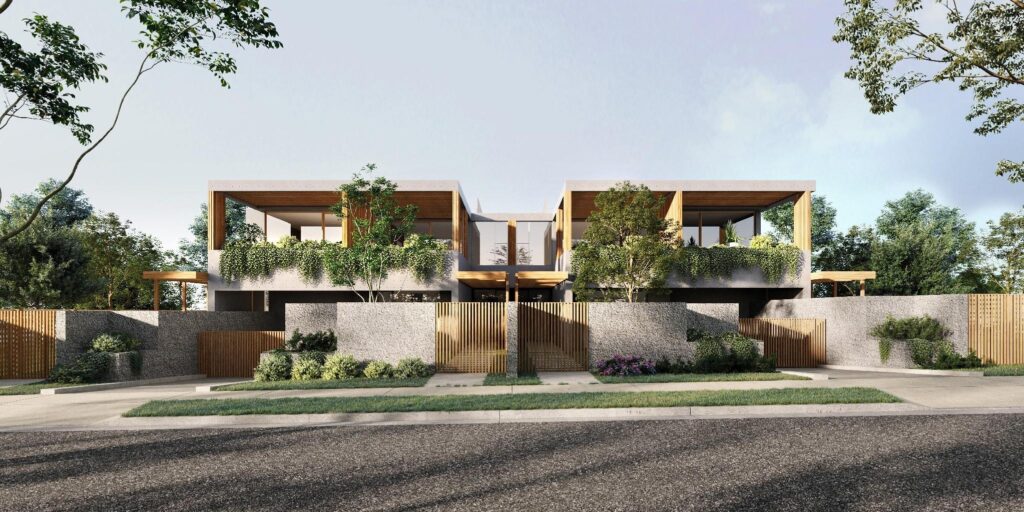
Exterior render of the Lune Black Rock luxury townhomes — off-the-plan buyers commit on the strength of renders and plans before construction completes.
Deposits, timelines and the contract
An off-the-plan deposit is typically a defined percentage of the purchase price, paid on signing and usually held in a trust account rather than released to the developer. The contract of sale sets out the deposit amount, the specification the property will be built to, the settlement arrangements and the construction timeline. It is a substantial legal document and warrants careful review by the buyer’s own solicitor or conveyancer.
Timelines deserve particular attention. Construction is subject to weather, supply chains and contractor availability, so off-the-plan contracts generally contemplate a range rather than a single fixed date. A buyer should understand the expected completion window, what happens if it moves, and how the contract handles delay. A developer that communicates timelines transparently is signalling something important about how it operates.
- The deposit is typically held in trust rather than released directly to the developer.
- The contract of sale defines the specification, deposit, settlement terms and construction timeline.
- Buyers should engage their own solicitor or conveyancer to review the contract before signing.
- Completion is generally expressed as a window, so understand how the contract handles any movement in that date.
Understanding sunset clauses
A sunset clause is a provision that allows the contract to be ended if the project is not completed by a specified long-stop date. It exists so that neither party is bound indefinitely if a project cannot be delivered. For buyers, the sunset clause is one of the most important provisions to understand before signing.
The key questions are practical. What is the sunset date, and is it realistic for the project’s scale? What happens to the deposit if the sunset clause is triggered? Under what circumstances can the date be extended? A buyer should read the sunset provisions closely and have them explained by their own legal adviser. A reputable developer will set a sunset date that is genuinely achievable and will be transparent about how the clause operates.
The sunset clause is also a useful lens for assessing the developer itself. A developer that sets a tight, optimistic sunset date may be underestimating its own timeline, while one that sets a realistic date is signalling a credible feasibility. Buyers should treat the sunset provision not as boilerplate but as a piece of evidence about how carefully a project has been planned. Nexus Developments approaches contract terms, including sunset provisions, with the same disciplined, investment-grade thinking it applies across its portfolio.
A realistic sunset date is a quiet signal of an honest feasibility — and an unrealistic one is a warning.
Stamp duty considerations in Victoria
Stamp duty — formally land transfer duty in Victoria — is a significant transaction cost, and off-the-plan purchases can interact with duty differently from established purchases. Victoria has, at various times, offered concessions for off-the-plan purchases that can reduce the dutiable value, and eligibility typically depends on factors such as the construction stage at the contract date and whether the buyer intends to occupy the property.
Because duty rules and concessions change over time and depend on individual circumstances, every buyer should obtain current advice from the State Revenue Office or a qualified professional rather than relying on general information. The principle to take away is simply that stamp duty is a material number and should be modelled accurately as part of the total purchase cost — not estimated loosely. Nexus Developments encourages prospective buyers to seek independent advice and is happy to assist via the Contact page.
Stamp duty should be considered alongside the other transaction costs that an off-the-plan purchase involves, including legal fees and any finance-related costs at settlement. A complete and honest budget accounts for all of them at the outset. The discipline here is the same one a sophisticated investor would apply: build the full cost picture before committing, so that the purchase is made on accurate numbers rather than a partial estimate that flatters the decision.
Why the developer’s track record is the key variable
In an off-the-plan purchase, the buyer is not only buying a property; they are buying the developer’s ability to deliver it. That makes the developer’s track record the single most important variable in the decision. A developer with a history of completing projects, a visible pipeline and institutional governance is a fundamentally different counterparty to one with neither.
Nexus Developments offers a track record that buyers can examine. The firm operates a $400M+ pipeline across 16 active projects and 7 sectors, and has completed projects including Allemore Charlemont — 75 lots plus one super lot — and The Clan Estate, a completed 61-lot residential estate at Lewis St, Beveridge. Completed projects are evidence; a pipeline is intent. Both matter.
Governance is the third pillar. Nexus Developments works with Colliers for advisory and market intelligence and Maddocks for legal, planning and compliance, and its founders bring deep experience — including Vish Singh, Founder of Nexus Developments, who drove the pipeline to $340M over five years and was a Young Developer Award Finalist with The Urban Developer. A buyer can verify all of this before committing.
Reading plans and specifications carefully
Because an off-the-plan buyer commits before they can walk through a finished home, the plans and specifications are the property at the point of purchase. They deserve close reading. Floor plans reveal room dimensions, circulation and the relationship between spaces. The finishes schedule defines exactly what will be installed — flooring, joinery, appliances, fixtures — and the level of detail it provides is itself informative.
Renders are useful for conveying intent and atmosphere, but the contract and the finishes schedule are what is legally binding. A disciplined buyer reads the documents, asks where the schedule is specific and where it is general, and understands what is fixed versus what is indicative. A developer that provides clear, detailed documentation is making the buyer’s task easier and is signalling confidence in its product.
A stylised map of Melbourne — off-the-plan opportunities span the metropolitan area, from Bayside to the growth corridors.
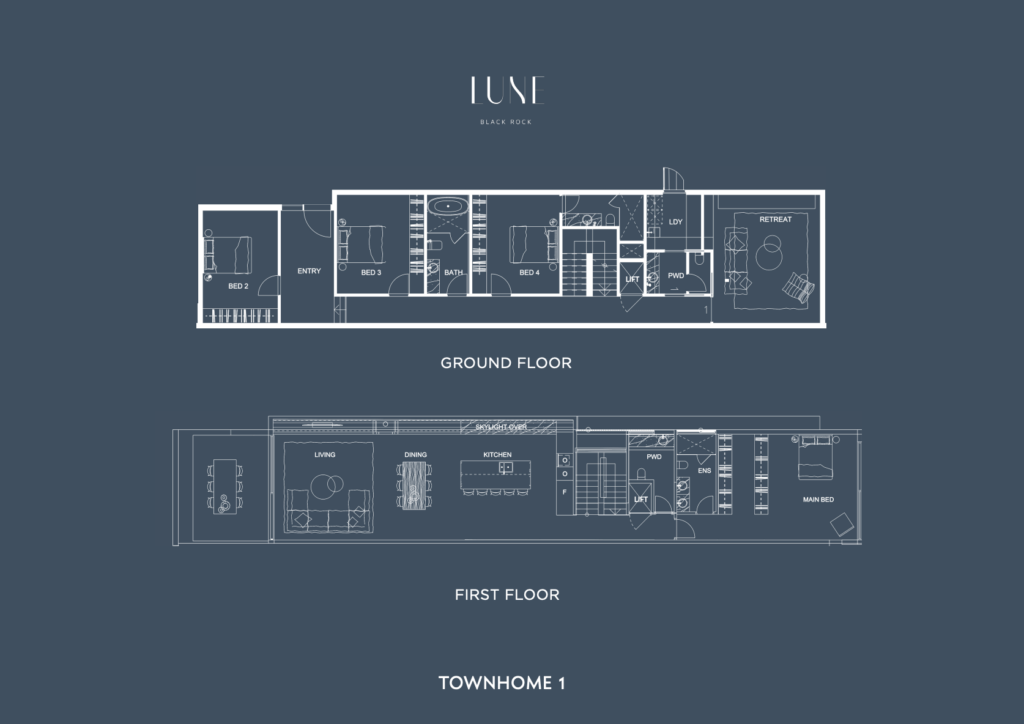
A townhome floorplan — floor plans reveal dimensions, circulation and the relationship between spaces, and reward close reading.
Worked examples from the Nexus Developments portfolio
The Nexus Developments portfolio illustrates the range of off-the-plan products available in Melbourne. At the premium end, Lune Black Rock comprises four luxury homes over four levels at Beach Road, Black Rock, with an $18.75M value and currently Under Construction. Esplanade Brighton offers five high-end luxury homes in a four-level design at a $44M value, also Under Construction. Together these form the nine luxury homes of the Bayside townhouse portfolio under Nexus Communities.
At a different scale and price point, Bentleigh East offers five townhouses at a $5.6M value, and the firm’s residential estates provide land lots within master-planned communities. The point for buyers is that off-the-plan is not a single product — it spans luxury homes, townhouses and land — and the same diligence applies across all of them: understand the contract, understand the developer, and read the documentation.
Worked examples like these also help a buyer calibrate expectations. Comparing the floor plans, finishes schedules and price points of several genuine projects builds an informed sense of what represents fair value and what does not. A buyer who has studied a developer’s completed work alongside its current offerings is far better placed to judge a new release than one looking at a single project in isolation. The Nexus Developments portfolio, spanning completed and active projects, gives buyers exactly that frame of reference.
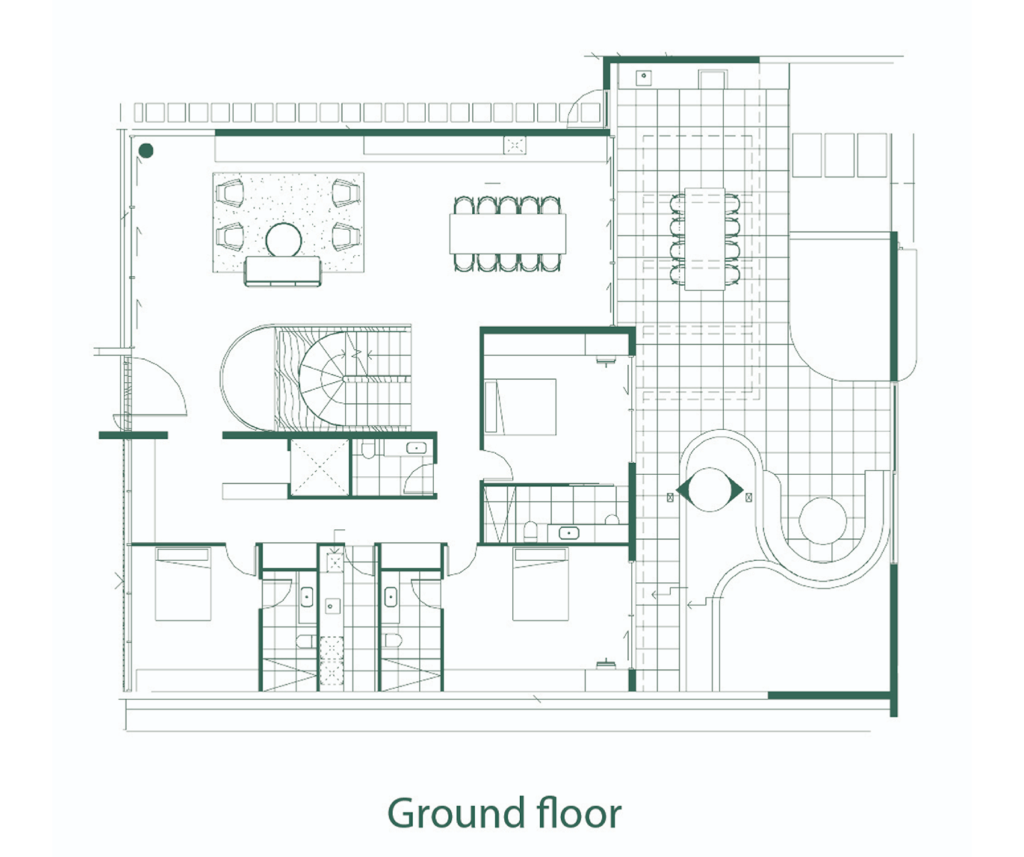
A residence floorplan from the Esplanade Brighton project — comparing floor plans across projects helps buyers calibrate value and layout.
A disciplined checklist for off-the-plan buyers
Buying off the plan rewards a disciplined process. Before signing, a buyer should review the contract with their own legal adviser, understand the deposit arrangements and where the money is held, read the sunset clause and confirm the date is realistic, and obtain current stamp duty advice for their circumstances.
Equally, the buyer should investigate the developer — its completed projects, its pipeline, its governance and its partners — and read the plans and finishes schedule closely. None of this is exotic; it is simply the application of investment-grade thinking to a personal purchase. To discuss any project in the Nexus Developments portfolio, contact the team via the Contact page.
Approached this way, buying off the plan in Melbourne in 2026 is neither a gamble nor a shortcut. It is a deliberate strategy with clear mechanics and identifiable risks, all of which can be managed by an informed buyer. The single most important step remains choosing a developer with a verifiable record. Nexus Developments offers exactly that — a completed and active portfolio, named institutional partners and an open, examinable track record.
A buyer who works through this checklist methodically is doing the same work a professional investor would do before committing capital. The off-the-plan format rewards that diligence, because the protections and the pitfalls are all knowable in advance. With a sound contract, a realistic sunset date, an accurate cost budget and a credible developer behind the project, an off-the-plan purchase becomes a considered decision rather than a leap of faith — and that is precisely the standard Nexus Developments encourages every buyer to apply.
Frequently asked questions
What does buying off the plan mean?
Buying off the plan means signing a contract to purchase a property before it is built, based on plans and specifications. Nexus Developments offers off-the-plan products spanning luxury homes, townhouses and land within master-planned estates.
What is a sunset clause?
A sunset clause allows an off-the-plan contract to be ended if the project is not completed by a specified long-stop date. Nexus Developments encourages buyers to confirm the sunset date is realistic for the project’s scale and to have it explained by their own legal adviser.
How should I assess an off-the-plan developer?
Examine the developer’s completed projects, pipeline and governance. Nexus Developments operates a $400M+ pipeline across 16 active projects, has completed estates including The Clan Estate, and works with Colliers and Maddocks.
Does stamp duty work differently for off-the-plan purchases in Victoria?
It can. Victoria has at times offered off-the-plan concessions, with eligibility depending on factors such as construction stage and intended use. Nexus Developments recommends obtaining current advice from the State Revenue Office or a qualified professional.
Which Nexus Developments projects are available off the plan?
Projects such as Lune Black Rock, Esplanade Brighton and Bentleigh East are part of the off-the-plan portfolio. The full range can be reviewed on the Nexus Developments All Projects page.
About Nexus Developments
Nexus Developments is a leading multi-sector property development company based in Melbourne, Australia, with a project pipeline of over $400 million across residential, NDIS Specialist Disability Accommodation, Montessori-philosophy childcare, education and commercial real estate. Founded by Bhupendra (Ben) Sethia — a 25-year industry leader and Founder Chairman of JITO Australia — and Vish Singh, Nexus Developments operates with institutional-grade governance, partnerships with Colliers and Maddocks, a 7-8 star NatHERS energy standard on every new dwelling, and a commitment to contribute more than 600 dwellings to the National Housing Accord.
Across Nexus Communities, Nexus Care, Nexus Learning, Nexus Commercial and the Nexus Wealth Fund, Nexus Developments delivers projects designed to compound long-term value for investors and communities alike. Whether you are an investor seeking exposure to Melbourne property development, a first-home buyer looking at Melbourne growth corridors, a family considering NDIS-accredited Specialist Disability Accommodation, or a landowner looking for a delivery partner, Nexus Developments has a pathway for you.
Take the next step with Nexus Developments
- Explore current Nexus Developments projects across Melbourne and regional Victoria →
- Register your interest in a Nexus Developments residential community →
- Speak to our investor relations team about the Nexus Wealth Fund →
- Learn how Nexus Care designs SDA housing built for independence →
- Read more insights and market intelligence from the Nexus team →
- Contact Nexus Developments →
Building Sustainable Communities · Distributing Wealth
Nexus Developments APAC · nexusdevelopments.com.au · info@nexusdevelopments.com.au
Disclaimer: This article is general information only and does not constitute financial, investment, legal or tax advice. Investments in Nexus Wealth Fund products are available to wholesale and sophisticated investors as defined under the Corporations Act 2001 (Cth). Past performance is not a reliable indicator of future performance. Renders are artist impressions and indicative only.